When the river rises.
Pluvial flooding & informal settlement exposure
in flight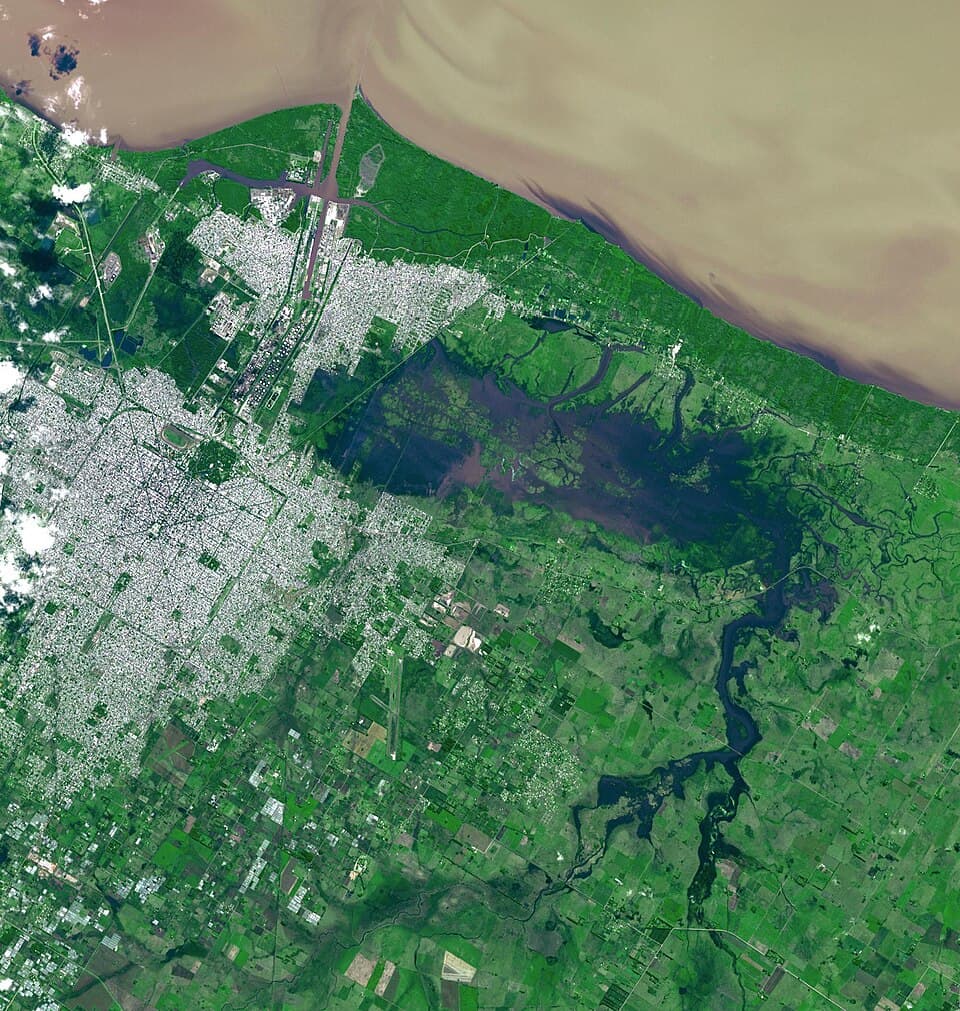 NASA/GSFC/METI/ERSDAC/JAROS, U.S./Japan ASTER Science Team (Public Domain)
- FLO-2D hydrological model outputs
- Google-Microsoft-OSM Open Buildings
- RENABAP informal settlement boundaries
- Municipal cadastre
- LiDAR-derived DEM
El desafío
La Plata experienced catastrophic flooding in April 2013, killing over 89 people and displacing thousands. The city's grid layout, designed in the 1880s, didn't account for the streams that once crossed the site — many now channeled underground. When heavy rainfall overwhelms the drainage system, water follows the old stream paths through basements and ground floors.
A critical challenge is understanding exposure in informal settlements (barrios populares). Official RENABAP data significantly underestimates the number of structures — our analysis found approximately 41,575 buildings missing from official records, representing 137,000–229,000 uncounted people. Traditional areal interpolation methods overestimate proportional exposure by assuming uniform population distribution.
Nuestro enfoque
This project combines flood hazard modeling with building-level exposure analysis:
Flood visualization: Using GRASS GIS, we applied Chaikin smoothing to flood hazard polygons from the Facultad de Ingeniería Hídrica. The process converted vector data to 2.5m raster, added edge noise for natural boundaries, and applied six iterations of smoothing. An interactive web map allows comparison of original and smoothed data against municipal cadastre.
Building-level exposure: Rather than areal interpolation, we count individual building footprints within flood hazard zones. This reveals that 17,014 buildings in barrios populares (23.5% of total) are exposed to flood hazard under the maximum probable precipitation scenario — 6,112 in high-hazard zones and 10,902 in medium-hazard zones.
Watershed analysis: Cuenca Arroyo del Gato has highest exposure with 7,943 buildings at risk, followed by Cuenca Maldonado (3,316) and Cuenca Martín-Carnaval (1,096).
Impacto
The analysis demonstrates that building footprint data improves both precision and comprehensiveness of risk mapping in informal settlements:
- Identified ~41,575 structures missing from official RENABAP records
- Villa Montoro leads exposure with 669 buildings in high-hazard zones (21.7% of neighborhood)
- Comparison of return periods shows PMP exposure can be 13x higher than 25-year return period — critical for relocation policy decisions
- Interactive flood map deployed for municipal planning use
- Methodology published as open-source Quarto book for replication
Gallery
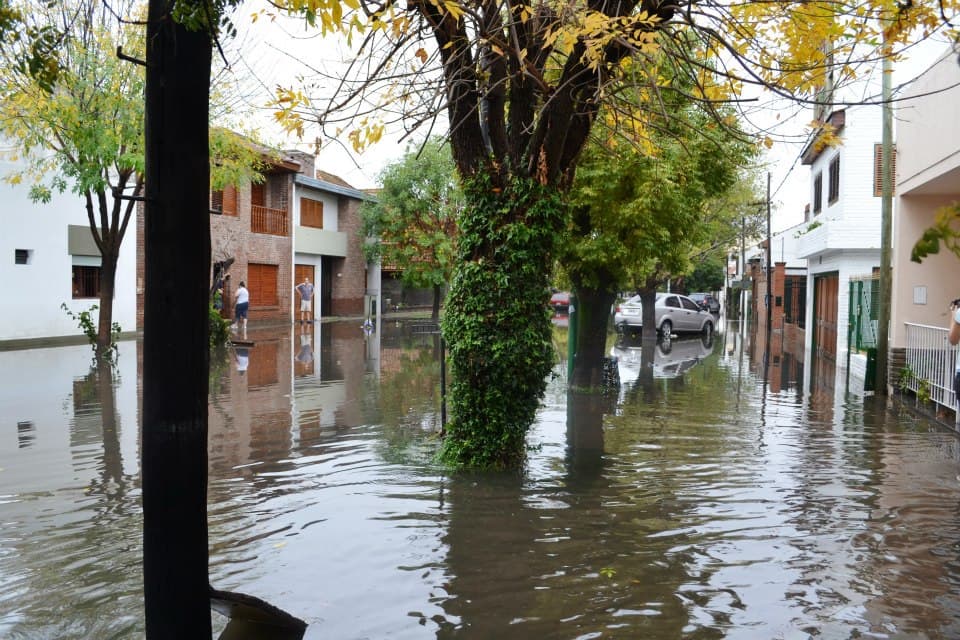
Street-level flooding in La Plata, April 2013
Press
- CIUT Riesgo: Análisis de exposición poblacional a peligros de inundación
Análisis detallado de la exposición de barrios populares al riesgo de inundación en el Partido de La Plata usando datos de huellas de edificaciones.
- Plan de Reducción del Riesgo de Inundaciones en la Región de La Plata
Metodología base del modelo hidrológico-hidráulico FLO-2D utilizado para generar los mapas de peligrosidad.
Notas técnicas
Data pipeline: GRASS GIS for polygon smoothing (Chaikin algorithm), Python/GeoPandas for spatial analysis, PMTiles for web mapping.
Key finding: Traditional areal interpolation overestimates proportional exposure (26.3% vs 23.5%) while underestimating absolute numbers. Building-level analysis provides more reliable estimates for both.
Validation: Building footprint methodology cross-validated against high-resolution satellite imagery in sample neighborhoods.
Citar este piloto
Lebovits, N., Etulaín, J.C., & Duarte, C. (2025). Building-level flood exposure analysis in informal settlements: La Plata, Argentina. CIUT-UNLP. https://nlebovits.github.io/ciut-riesgo/